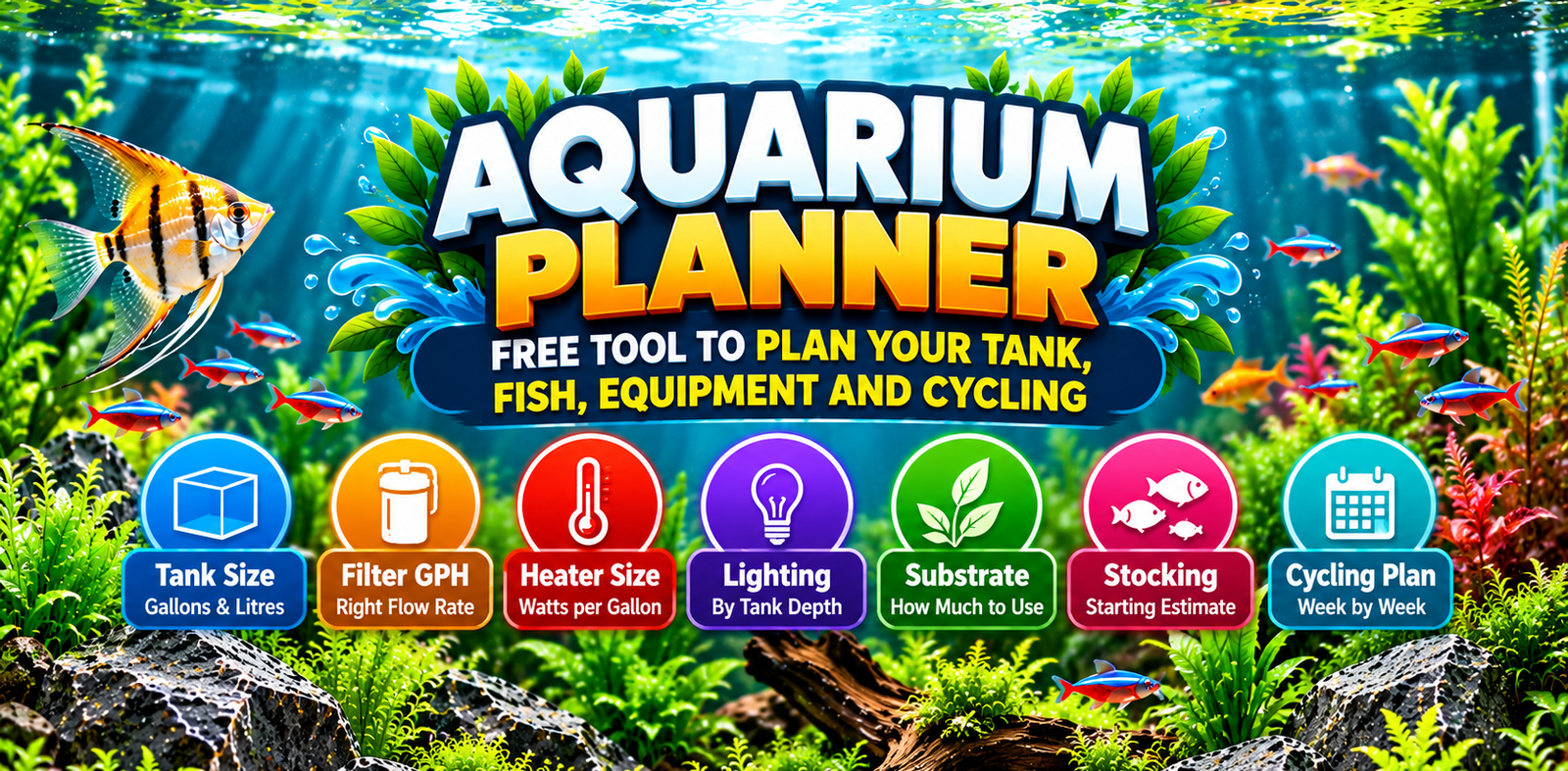
Aquarium Planner | Free Tool to Plan Your Tank, Fish, Equipment and Cycling
Planning a healthy aquarium starts before you buy your fish. This free aquarium planner helps you estimate tank volume, filled weight, filtration, heater wattage, lighting, substrate and a sensible starting stocking level. It also provides a fishless cycling timeline and a practical shopping checklist.
Use it as a fish tank planner for a small freshwater community or as an initial aquarium setup calculator for a larger project. The estimates are starting points, not guarantees of compatibility or fish welfare. Always check the needs and adult size of each species before purchasing.
Aquarium Planner Tool
Choose a preset tank or enter your own dimensions. Select your fish group and room temperature to receive a preliminary equipment plan. The calculator uses US gallons for its calculations and displays litres as well. Print or save the checklist when you are ready to shop.
Enter your tank details and select “Calculate my aquarium plan” to see your results.
Important: These are rules of thumb only. Adult size, species behaviour, water chemistry and maintenance matter more than any formula. Goldfish and marine systems have specialised requirements that a general calculator cannot fully assess.
What Is an Aquarium Planner and Why Use One?
An aquarium planner brings the main setup decisions into one place. Instead of estimating tank capacity, buying a filter at random and choosing fish later, you can plan the tank around its future occupants. An aquarium setup calculator helps you compare dimensions and equipment, while a fish tank setup checklist reduces the risk of forgetting essential supplies.
This tool combines volume, approximate filled weight, filter flow, heater guidance, substrate estimates and a cycling schedule. For more focused calculations, use the Aquarium Stocking Calculator and the Gravel Calculator.
AqAdvisor Alternative That Works on Your Phone
AqAdvisor is a known stocking and filtration planning resource. This AquariumsWorld tool adds broader setup estimates for heaters, lights, substrate, cycling and a printable checklist. Neither tool replaces species-specific research or testing your aquarium water.
Step 1: Choose Your Tank Size and Location
Tank size affects swimming space, equipment requirements, cost and water stability. A larger aquarium usually dilutes waste more effectively than a very small one, although it still needs appropriate filtration and maintenance. For many beginners, a 20 to 40 gallon freshwater aquarium offers a useful balance between space and manageability.
Before buying, measure the proposed location and confirm that the floor and stand can support the aquarium’s filled weight. Keep the tank away from direct sunlight, heating vents and frequent temperature changes. Place it near a safe electrical outlet and leave room to clean the glass and maintain the filter.
Read our 20 Gallon Fish Tank guide for dimensions and setup considerations, and use the fish tank dimensions and weight comparison when comparing footprints.
Fish Tank Size Calculator: Gallons, Litres and Weight
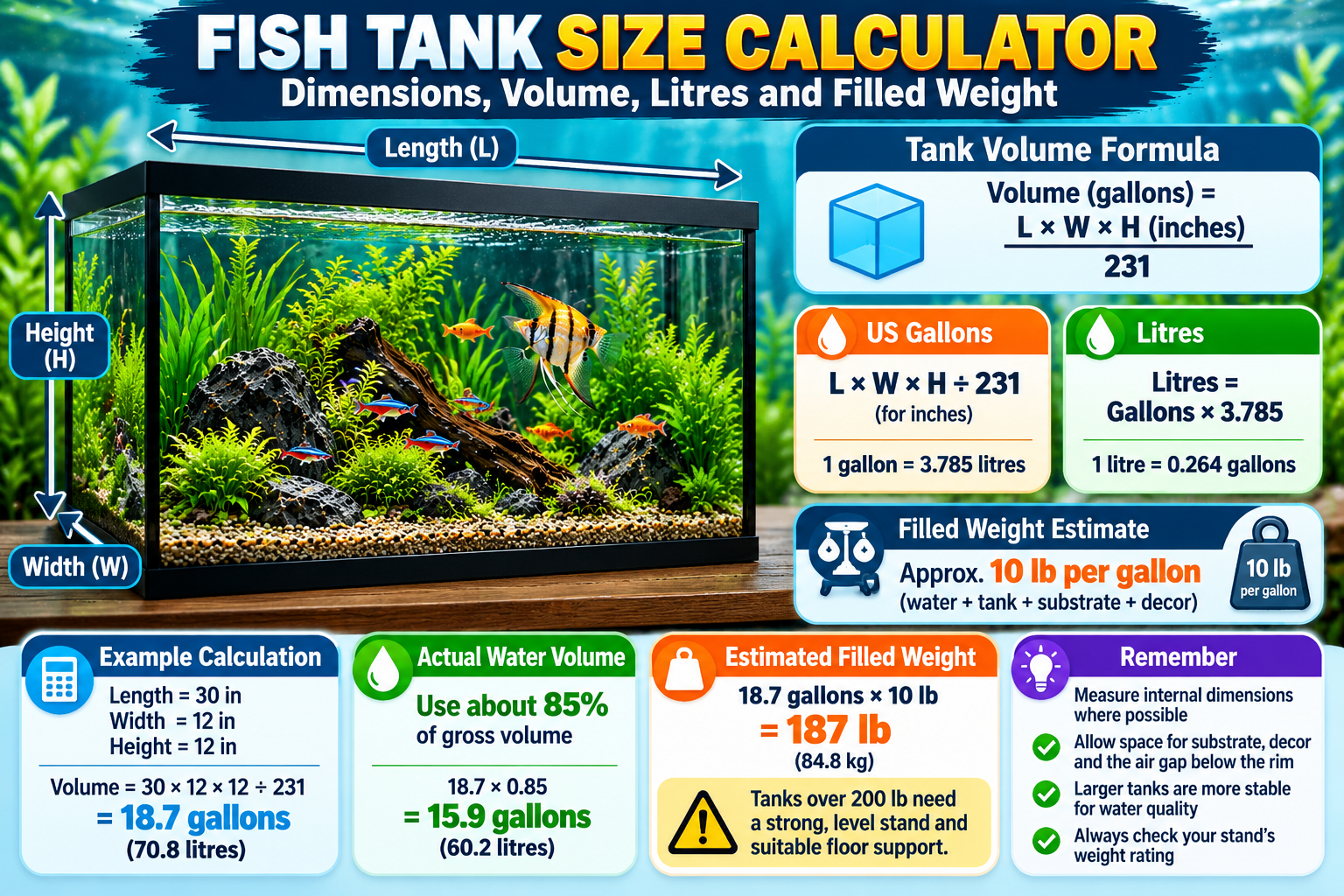
For a rectangular tank measured in inches, multiply length by width by height, then divide by 231 to estimate US gallons. Multiply gallons by 3.785 to convert to litres. The result is gross volume: substrate, rocks, equipment and the air gap below the rim reduce the water actually held.
A planning estimate of 10 pounds per gross gallon can help flag a potentially heavy setup, but the true weight depends on tank construction and materials. A filled aquarium weighing more than 200 pounds needs a suitably rated, level support. Large tanks may require additional consideration of the floor and location.
Step 2: Pick Freshwater or Saltwater
| Consideration | Freshwater | Saltwater |
|---|---|---|
| Initial complexity | Generally simpler for a first aquarium | Requires salinity management and marine-specific planning |
| Equipment | Filter, and usually heater for tropical fish | Marine filtration; reef tanks may need additional specialised equipment |
| Water testing | Ammonia, nitrite, nitrate and pH are core tests | Core tests plus salinity; reef systems need additional chemistry monitoring |
| Fish selection | Choose compatible freshwater species | Choose marine species with matching habitat requirements |
Freshwater is often the more forgiving starting point, but success still depends on cycling, suitable stocking and routine testing. Marine keepers can review our marine aquarium water test kit guide before buying equipment.
Step 3: Choose Your Fish
Choose fish by adult size, temperature range, behaviour, water chemistry and social needs, not colour alone. A peaceful schooling species may need a group, while a territorial fish may need its own space. Temperature preferences also matter: species that appear compatible in a shop may require different long-term conditions.
For example, read our care guides before planning around Pigeon Blood Discus, Copper Oscar Fish or Queen Angelfish. These fish have very different space and care needs; they should not be treated as interchangeable options for a beginner community tank.
Aquarium Fish Compatibility Chart
| Group | Typical planning approach | Check before buying |
|---|---|---|
| Small community fish | Plan appropriate schools and swimming space | Temperature, adult size and group size |
| Betta | Plan around one betta’s needs first | Fin-nipping tank mates, flow and hiding places |
| Goldfish | Allow substantial space and strong waste processing | Adult variety, tank size and filtration |
| Cichlids | Plan territories and adult behaviour | Aggression, breeding behaviour and water chemistry |
| Marine fish | Use a marine-specific stocking plan | Salinity, reef compatibility and adult size |
This is a broad screening chart, not a guarantee of compatibility. Research each proposed species and make sure their temperature and water chemistry needs overlap.
For planted betta setups, explore our guides to the best plants for betta fish tanks and 15 live plants for bettas. A planted layout should still leave suitable swimming space and allow easy maintenance.
Step 4: Plan Your Stocking Level
Stocking capacity cannot be reduced to a single number. Fish differ in adult size, activity, waste production and social needs. Treat any aquarium stocking calculator as an initial screening tool, then verify each species’ minimum tank size and group requirements.
Aquarium Stocking Calculator vs the 1 Inch per Gallon Rule
The one-inch-per-gallon rule ignores body mass, behaviour and waste production. It is particularly unsuitable for goldfish, large cichlids and other high-bioload fish. Use the Aquarium Stocking Calculator alongside our guide to how many fish can be in a 10-gallon tank. Add livestock gradually and monitor water quality after each addition.
Step 5: Size Your Equipment
Filtration, heating and lighting should suit the tank volume and the needs of its inhabitants. A kit can simplify purchasing, but check which components are actually included and whether they are suitable for your chosen fish and plants.
Aquarium Filter GPH Calculator
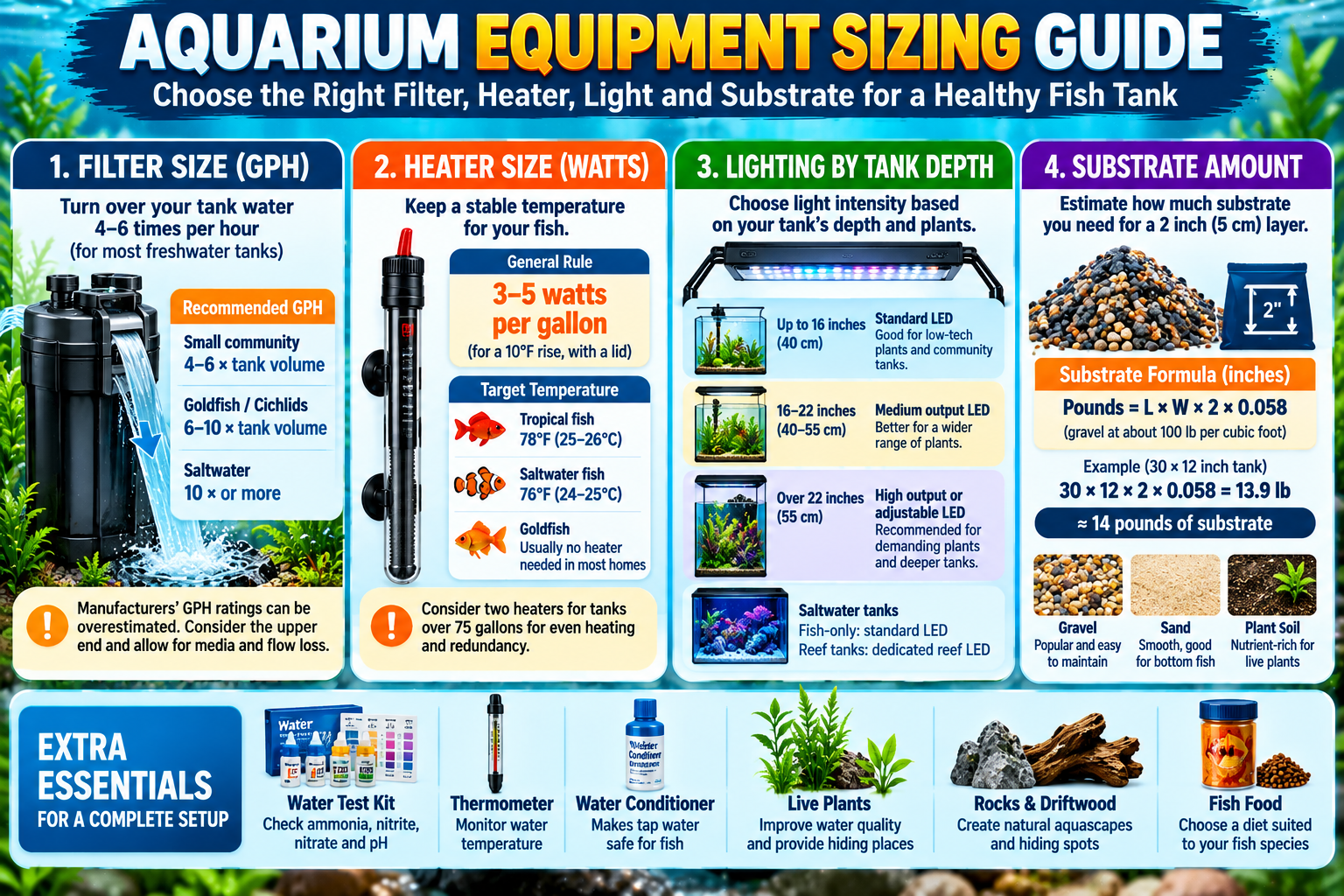
GPH means gallons per hour. A rough starting range for a freshwater community is four to six times gross tank volume per hour. Heavy-waste fish may need greater filtration and maintenance. Manufacturer flow ratings are often measured under favourable conditions and can decline as media collects debris, so consider the upper end when appropriate. Flow must also suit fish that dislike strong currents.
Aquarium Heater Size Calculator
Heater selection depends on tank volume, the target temperature and the difference between room and aquarium temperature. A common starting guideline is around five watts per gallon for a rise of approximately 10°F, but room conditions and tank design change the requirement. Large tanks may benefit from two appropriately sized heaters for more even heating and redundancy. Always confirm temperature with a separate thermometer.
Lighting by Tank Depth
For low-tech planted tanks up to about 16 inches deep, a standard planted-tank LED may be sufficient. Deeper tanks or demanding plants may require higher-output or adjustable lighting. Saltwater fish-only tanks and reef systems have different lighting needs. Begin with a consistent photoperiod and adjust it to plant growth and algae levels.
For plant selection, see 15 easy low-tech aquarium plants. A low-tech design can reduce equipment complexity, but light intensity, nutrients and plant choice still need to work together.
Step 6: Plan Substrate, Rocks and Plants
Substrate and hardscape affect appearance, planting options and the usable volume of the aquarium. Fine sand can suit bottom-dwelling fish, while gravel is convenient for many community tanks. Nutrient-rich substrates can support rooted plants but may need a different maintenance approach from inert gravel.
Aquarium Substrate Calculator
For a simple estimate, multiply tank length by width by the planned substrate depth to find the bed volume. The required weight depends on material density, so gravel and sand will not weigh exactly the same for an identical volume. Our aquarium gravel calculator can help estimate how much substrate to buy.
Choose rocks carefully and test uncertain materials outside the aquarium. Some stones can raise hardness or pH. Read our guide to safe stones for fish tanks before adding natural stone. Use the soil in fish tank guide if you are considering a planted substrate.
Step 7: Set a Realistic Budget
Plan for more than the tank itself. Your budget should cover a stable stand, filter, heater where needed, light, substrate, water conditioner, a suitable test kit, food and maintenance tools. Reserve some money for replacement filter media and unexpected equipment needs.
| Budget level | Planning approach | Potential trade-off |
|---|---|---|
| Starter | Consider an all-in-one kit with core equipment | Included filter or light may limit future upgrades |
| Mid-range | Choose separate components matched to the tank | Requires more research before purchasing |
| Premium | Consider advanced filtration and programmable lighting where justified | Higher upfront cost and potentially more complex maintenance |
Do not buy fish before budgeting for water testing and routine care. Test kits help you identify problems before they become emergencies. Compare options in our aquarium water test kit comparison. A feeder may be useful for some routines, but it does not replace observation or maintenance; see our automatic fish feeder guide.
Step 8: Cycle the Tank Before Adding Fish
New aquariums need time for beneficial microorganisms to establish in the filter and other surfaces. During the nitrogen cycle, microorganisms process toxic ammonia into nitrite and then nitrate. Both ammonia and nitrite can harm fish, so the tank should be cycled before livestock is introduced.
A fishless cycle commonly takes around four to six weeks, but timing varies with temperature, water chemistry, the source of bacteria and other conditions. A bottled bacteria starter may help, but it is not proof that the aquarium is ready. Test water and confirm the cycle has completed rather than relying on the calendar alone.
How to Test and Support the Cycle
Use a reliable test kit to monitor ammonia, nitrite and nitrate. Test regularly during cycling and follow the directions for any bacteria starter. Do not add fish simply because the water looks clear; harmful compounds are not necessarily visible. Our test kit comparison explains what different kits measure.
Once ammonia and nitrite remain at zero after an appropriate ammonia source has been processed, and nitrate is detectable where expected, verify that the aquarium can handle its intended biological load. Continue testing after introducing fish and add them gradually. For further maintenance context, see our Microbe-Lift Nite-Out II guide; products are aids, not substitutes for testing.
Your Aquarium Starter Checklist
Use this fish tank setup checklist before bringing home livestock. Check each item as it is purchased or prepared.
Sample Aquarium Plans: 10, 20 and 40 Gallons
These examples illustrate how a fish tank planner can guide initial equipment choices. They are not final stocking prescriptions. Adjust all equipment to the actual tank, manufacturer instructions, livestock and local room conditions.
| Tank | Approximate filter target | Heater starting point | Substrate at 2 inches | Planning idea |
|---|---|---|---|---|
| 10 gallons | 40–60 GPH for a modest community | Usually around 50 W, depending on room temperature | About 5–7 lb for a typical footprint; verify material density | One carefully selected small species setup |
| 20 gallons | 80–120 GPH for a community | Often 75–100 W depending on temperature difference | About 10–15 lb depending on footprint and density | Planted community with compatible small fish |
| 40 gallons | 160–240 GPH as a community starting range | Often 150–200 W, subject to room conditions | About 20–30 lb depending on footprint and density | More swimming space and flexibility for a planned community |
Substrate weights are approximate because aquarium footprints and material density vary. The calculator estimates substrate from tank length and width; for a more accurate shopping quantity, use the gravel calculator. For larger setups, review our 100 gallon fish tank guide.
Frequently Asked Questions
How do I plan an aquarium?
Choose a suitable tank and location, decide on freshwater or saltwater, select compatible fish, estimate stocking, size equipment, plan substrate and plants, set a budget and cycle the tank. Use water tests to confirm readiness before adding livestock.
What is the best size aquarium for a beginner?
A 20 to 40 gallon freshwater aquarium can be a forgiving starting point for many beginners because the extra water volume can buffer changes better than a very small tank. The best size still depends on available space, budget and the adult needs of the chosen fish.
What is the 1 inch per gallon rule?
It is a rough old guideline that suggests one inch of fish per gallon. It does not account for body mass, waste, behaviour or group needs and should not be used as the main stocking method, especially for goldfish or cichlids.
What size filter do I need for my aquarium?
A rough freshwater community starting point is four to six times the tank’s gross volume per hour. Heavy-waste fish may need more capacity and maintenance. Check actual filter performance, media space and whether the current is suitable for the fish.
How many watts heater do I need per gallon?
A common starting guideline is around three to five watts per gallon, depending on how much warmer the tank must be than the room. Follow the heater manufacturer’s guidance and verify the water temperature using a separate thermometer.
How long should a new tank run before adding fish?
A fishless cycle often takes four to six weeks, but there is no guaranteed fixed duration. Add fish only when water tests confirm the cycle is functioning, with ammonia and nitrite at zero and other parameters suitable for the planned species.
Final Thoughts on Using an Aquarium Planner
A reliable aquarium planner helps you make connected decisions before spending money or bringing fish home. Use the calculations to estimate your tank volume, weight, filter, heater and substrate, but treat them as starting points. Species requirements, water testing, cycling and regular maintenance determine whether the finished aquarium will thrive.
Run the calculator again whenever you change tank dimensions or your planned fish group. Save the checklist, research adult fish sizes and use the related AquariumsWorld guides to refine your setup. A little planning before purchase can prevent expensive equipment mistakes and protect the animals in your care.
References
- Camargo, J.A., Alonso, A. and Salamanca, A. (2005) ‘Nitrate toxicity to aquatic animals: a review with new data for freshwater invertebrates’, Chemosphere, 58(9), pp. 1255–1267. https://doi.org/10.1016/j.chemosphere.2004.10.044
- Ellis, T. et al. (2002) ‘The relationships between stocking density and welfare in farmed rainbow trout’, Journal of Fish Biology, 61(3), pp. 493–531. https://doi.org/10.1111/j.1095-8649.2002.tb00893.x
- Kroupova, H., Machova, J. and Svobodova, Z. (2005) ‘Nitrite influence on fish: a review’, Veterinarni Medicina, 50(11), pp. 461–471. https://doi.org/10.17221/5650-VETMED
- Kuhn, D.D. et al. (2010) ‘Evaluation of nitrifying bacteria product to improve nitrification efficacy in recirculating aquaculture systems’, Aquacultural Engineering, 43(2), pp. 78–82. https://doi.org/10.1016/j.aquaeng.2010.07.001
- López-Olmeda, J.F. and Sánchez-Vázquez, F.J. (2011) ‘Thermal biology of zebrafish (Danio rerio)’, Journal of Thermal Biology, 36(2), pp. 91–104. https://doi.org/10.1016/j.jtherbio.2010.12.005
- Näslund, J. and Johnsson, J.I. (2016) ‘Environmental enrichment for fish in captive environments: effects of physical structures and substrates’, Fish and Fisheries, 17(1), pp. 1–30. https://doi.org/10.1111/faf.12088
- Oldfield, R.G. (2011) ‘Aggression and welfare in a common aquarium fish, the Midas cichlid’, Journal of Applied Animal Welfare Science, 14(4), pp. 340–360. https://doi.org/10.1080/10888705.2011.600664
- Randall, D.J. and Tsui, T.K.N. (2002) ‘Ammonia toxicity in fish’, Marine Pollution Bulletin, 45(1–12), pp. 17–23. https://doi.org/10.1016/S0025-326X(02)00227-8